
Carved into a steep Andean hillside, thousands of white salt pools cascade down toward the valley floor. From a distance, they look almost unreal. Up close, they reveal something deeper: a living system that has shaped local life for centuries and continues to function much as it always has.
The Maras Salt Mines are not ruins. They are working terraces, maintained by local families, and one of the most distinctive cultural landscapes in the Sacred Valley.
Why the Maras Salt Mines Are Important
Salt was a strategic resource in the Andes long before the Inca Empire. The Maras salt springs were already in use during pre-Inca times and later incorporated into the Inca economic system, supplying salt to communities across the region.
Unlike centralized state-controlled resources, Maras developed as a communal system. Individual families manage specific pools, passing them down through generations. This continuity. pre-Inca, Inca, colonial, and modern, makes Maras one of the clearest examples of uninterrupted Andean tradition in the Sacred Valley. Its importance is not only historical. The salt produced here is still used locally and sold throughout Peru.
Where Are the Maras Salt Mines Located?
The salt mines are located near the village of Maras, high above the Urubamba Valley, at approximately 3,380 meters / 11,090 feet above sea level.
They sit between several key Sacred Valley sites:
- About 10 km from Moray
- Around 45 minutes from Urubamba
- Roughly 1.5 hours from Cusco
How the Maras Salt Mines Work

At the heart of Maras is a natural underground salt spring. Highly saline water emerges from the mountain and is carefully channeled through a network of narrow canals.
From there, gravity distributes the water into thousands of shallow evaporation pools. Sun and wind slowly evaporate the water, leaving behind crystallized salt.
Key aspects of the system:
- The pools belong to a local families
- Maintenance follows ancestral methods
- Production depends heavily on dry-season weather
- Salt harvesting happens several times per year
Visiting the Maras Salt Mines: What the Experience Is Like

Walking through Maras is a visual and sensory experience. Narrow paths wind between pools of varying colors: bright white, pale pink, and earthy brown depending on mineral content and harvest stage.
Visitors move through designated walkways, stopping at viewpoints overlooking the entire complex. During active harvesting periods, you may see workers raking salt by hand, reinforcing that this is a functioning landscape, not an open-air museum.
The experience is open and exposed, with little shade, making weather and timing important considerations.
How to Get to the Maras Salt Mines
| From Cusco | -Approximately 1.5–2 hours by car -Best accessed via guided tour or private transport |
| From Urubamba | -Around 45 minutes -Ideal base for independent exploration |
| From Ollantaytambo | -About 1 hour by car -Easy to combine with Moray |
Guided vs Independent Visits
Guided tours provide historical context and help connect Maras to nearby sites like Moray. Independent visits offer flexibility but require arranging transport to and from the site.
Best Time to Visit Maras
- Dry season (May–September): Best conditions, active salt production, clearer views
- Rainy season (November–March): Fewer visitors, greener surroundings, but limited production
Early morning or late afternoon offers softer light and fewer crowds.
What to Know Before You Go
- Entrance fee supports the local community
- Paths can be uneven and slippery
- Bring sun protection, there is little shade
- Respect private family pools and posted boundaries
- Weather can change quickly at this altitude
What to Do Around Maras
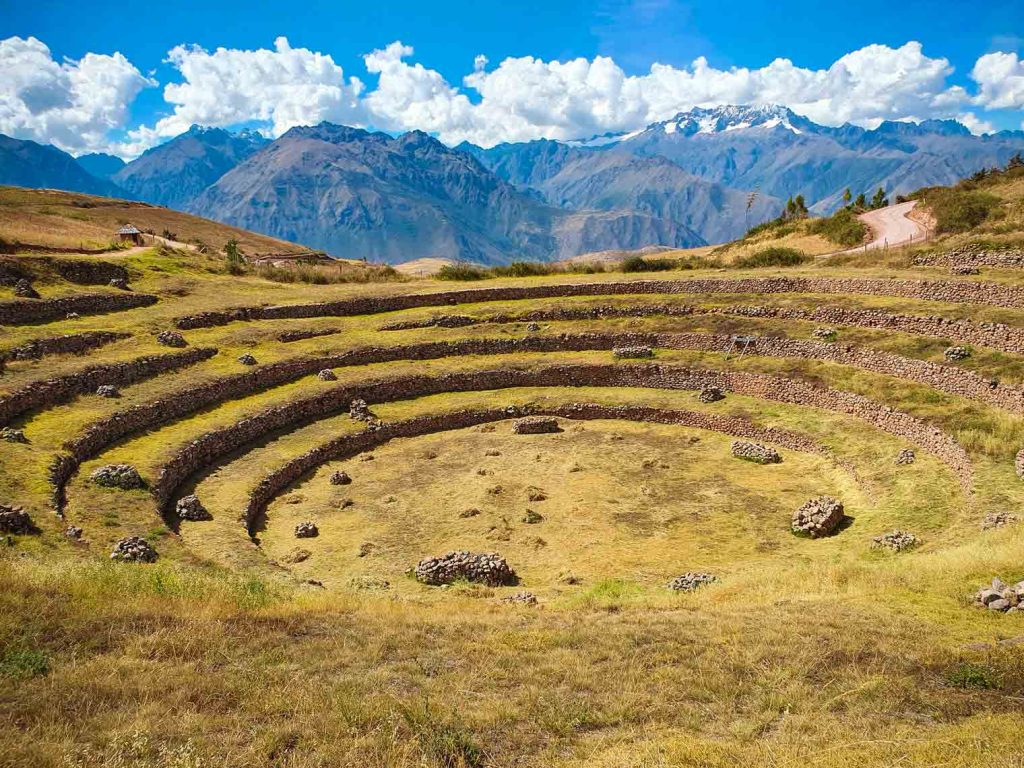
Exploring Moray Archaeological Site
Just a short drive away, Moray’s circular terraces provide essential context. While Maras shows resource extraction, Moray demonstrates agricultural experimentation. Together, they illustrate Inca mastery of environment and microclimates.
Horseback Riding Around Maras
The open highland plains around Maras are well suited for horseback riding. Routes pass near Moray, across rolling terrain, and toward viewpoints overlooking the salt mines, offering a slower, landscape-focused way to explore the area.
Combined Maras & Moray Visits
Maras and Moray naturally complement each other and are often visited together. Combining them creates a fuller understanding of Andean land use, from experimentation to production, within a single half-day or full-day outing.
Who Should Visit the Maras Salt Mines?

Maras is ideal for:
- First-time Sacred Valley visitors
- Travelers interested in living traditions
- Landscape and photography-focused travelers
- Those looking for meaningful short excursions
Why Maras Is More Than a Photo Stop
Maras is often photographed, but rarely understood. Beyond its striking appearance lies a system that reflects Andean ingenuity, communal organization, and deep respect for natural processes.
When visited with context, and ideally paired with Moray, Maras becomes more than a quick stop. It becomes a clear example of how the Sacred Valley was shaped, and continues to be shaped, by people working in balance with the land.
FAQS
How old are the Maras salt mines?
They date back to pre-Inca times and have been used continuously since.
Are the salt mines still active?
Yes. Local families continue to harvest salt using traditional methods.
Can you buy salt on site?
Yes. Small bags of Maras salt are sold near the entrance.
How long does a visit take?
Most visits last between 45 minutes and 1.5 hours.