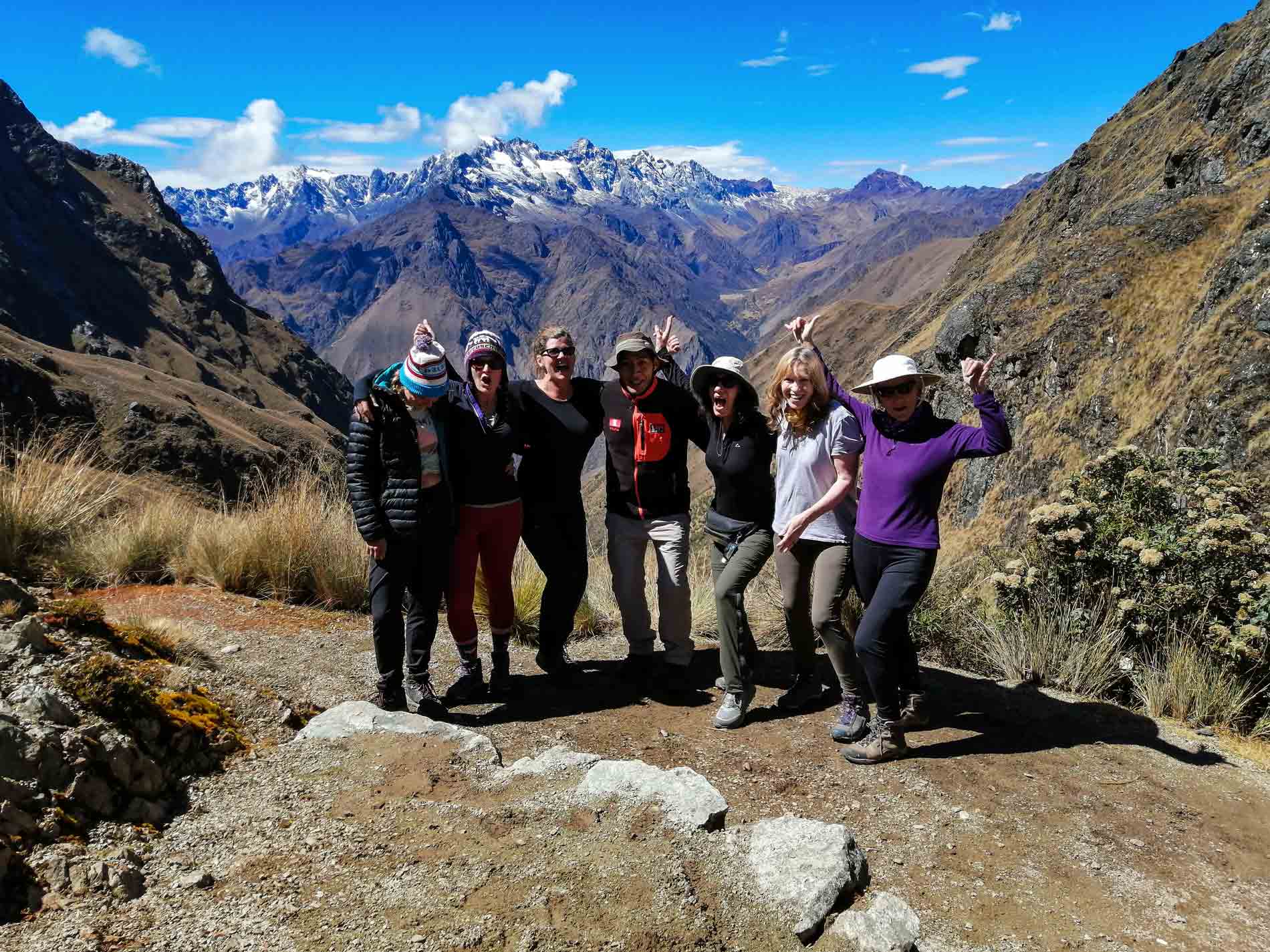
Preparing for the Classic 4-Day Inca Trail to Machu Picchu is one of the most exciting parts of your Peru trip, but it is also where many travelers get overwhelmed by unrealistic advice.
Most fitness guides tell you that you need 3 to 6 months of grueling daily gym workouts to survive the trail. In reality, thousands of everyday travelers complete the Inca Trail every year with only a few weeks of preparation.
This comprehensive guide covers both the Express 2 to 4-Week Emergency Plan for short-timeline travelers and the Optimal 12-Week Training Strategy for early planners.
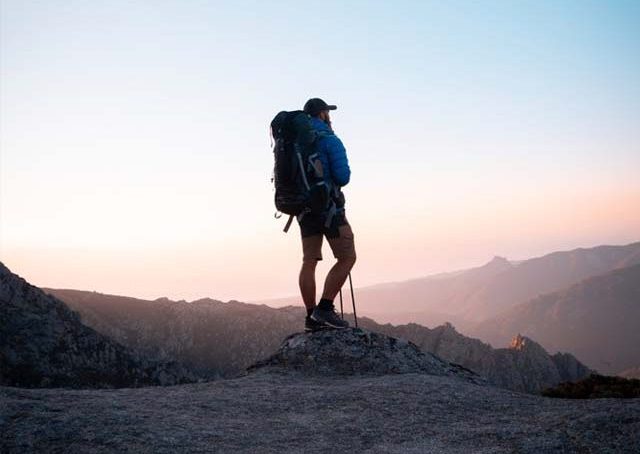
How Hard Is the Inca Trail & How Do You Prepare?
The Classic 4-Day Inca Trail covers 42 kilometers (26 miles) and reaches a maximum elevation of 4,215 meters (13,828 feet) at Dead Woman’s Pass. It is rated moderate to challenging. The trek is not a technical climb, it requires no ropes or climbing gear—but it demands multi-day physical endurance across thousands of uneven Incan stone stairs.
To prepare effectively, your training must focus on stair climbing, eccentric quad strength for downhill descents, breaking in your boots, and proper altitude acclimatization.
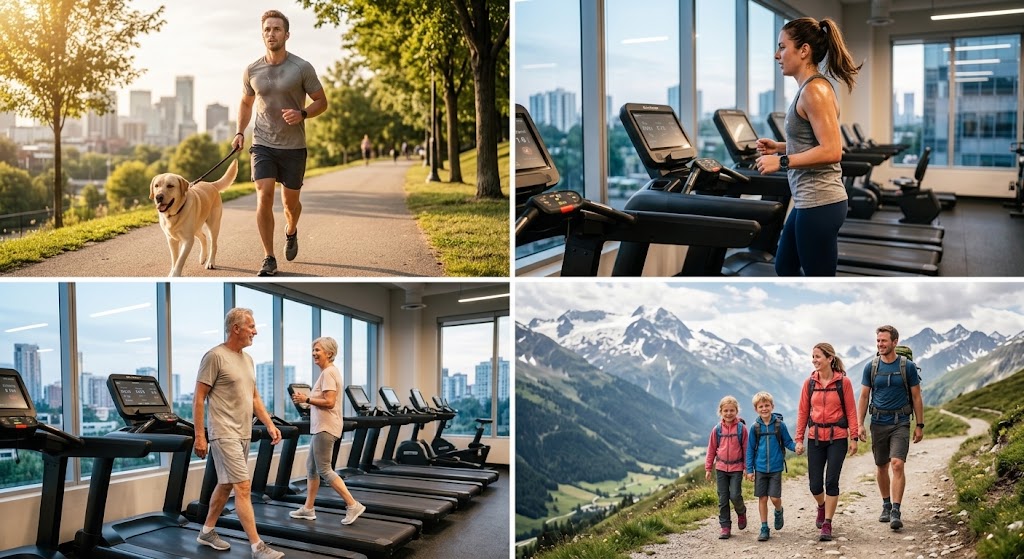
The Reality Check: Physical Fitness vs. Altitude Sickness
Here is the most important secret about trekking in Peru: Physical fitness does not make you immune to altitude sickness.
It is very common to see marathon runners struggle on Day 2 of the Inca Trail because they rushed into the mountains without acclimating, while average, unconditioned travelers who spent 2 to 3 days relaxing in the Sacred Valley feel fantastic throughout the trek.
Rule #1: Proper Acclimatization > Months of Gym Time
If you must choose between squeezing in extra gym workouts or spending an extra day acclimatizing in the Sacred Valley before your trek, choose the extra day of acclimatization every single time. Ideally 2 to 3 days if you can.
Inca Trail Difficulty Breakdown: Day by Day
Understanding the daily profile of the trail helps you train the right muscles:
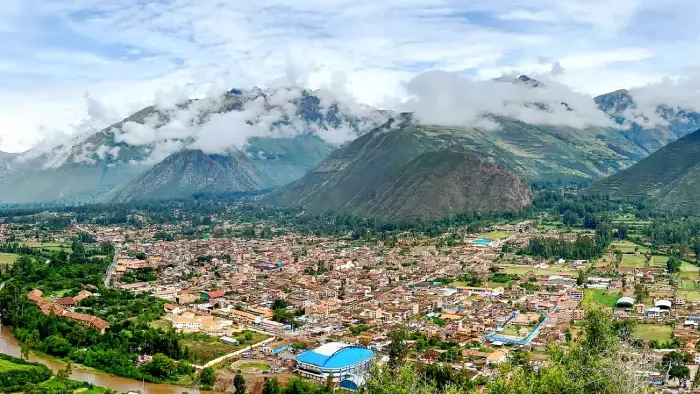
Day 1: The Gentle Warmup
- Challenge Level: Easy to Moderate. A great warm-up day for your legs.
- Distance: 12 km (7.5 miles)
- Terrain: Undulating dirt paths along the Urubamba River.
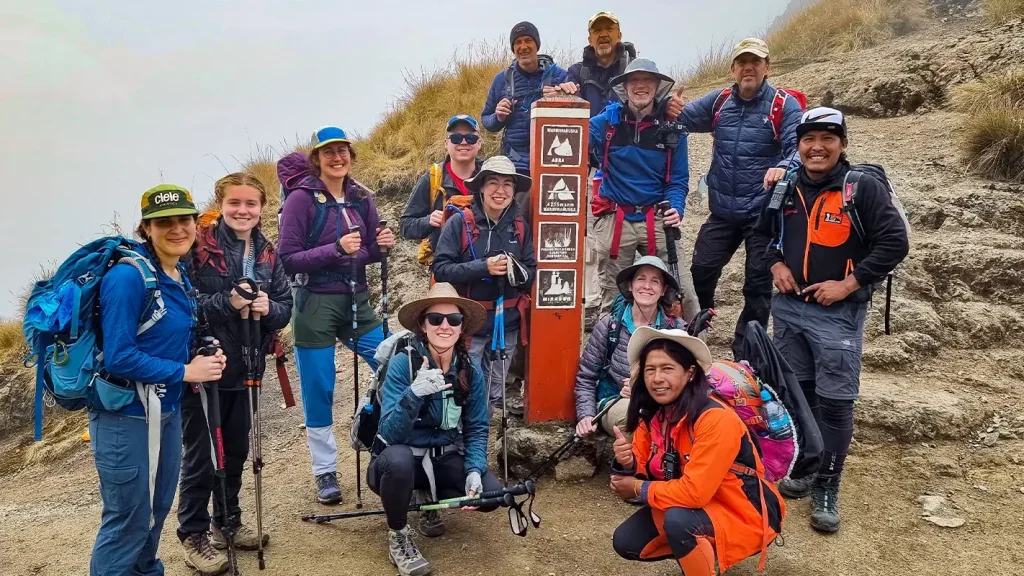
Day 2: The High-Altitude Climb (Dead Woman’s Pass)
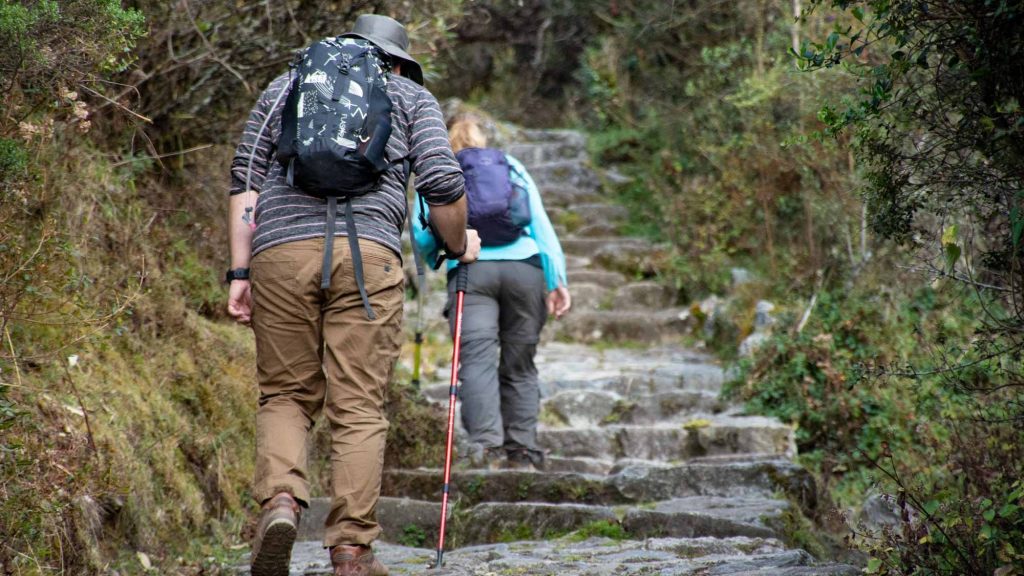
- Challenge Level: Physically Demanding. You will climb stone staircases continuously for 4 to 5 hours in thin air.
- Distance: 11 km (6.8 miles)
- Highest Point: 4,215 m (13,828 ft) at Warmiwañusqa (Dead Woman’s Pass).
Day 3: The Great Incan Descent
- Distance: 16 km (10 miles)
- Terrain: Over 3,000 uneven, descending Incan stone steps.
- Challenge Level: High Impact. This day causes the most muscle soreness because your quadriceps act as continuous brakes while stepping down stone stairs.
Day 4: The Final Push to Machu Picchu
- Distance: 5 km (3 miles)
- Highlight: Arrival at Inti Punku (Sun Gate) overlooking Machu Picchu.
- Challenge Level: Moderate. A short morning hike followed by a guided tour of the citadel.
Option A: The 2 to 4-Week “Express” Emergency Plan
If your trip is just around the corner and you have not been training, do not panic. Follow this 4-week crash course to get your body trail-ready without overtraining.
Week 1: Boot Break-In & Daily Walking
- Action: Stop wearing everyday sneakers. Wear your actual hiking boots daily, to work, around the house, and on evening walks.
- Focus: Softening boot leather and identifying any hot spots on your feet early.
Week 2: StairMaster & Leg Shock Training
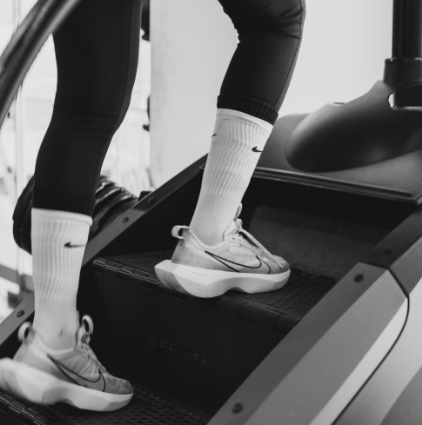
- Action: Visit the gym twice this week for 30 minutes on the StairMaster or climb outdoor stadium stairs.
- Focus: Maintain a slow, deliberate cadence. Step with your entire foot flat on the pedal rather than pushing off your toes.
Week 3: Loaded Daypack Practice
- Action: Fill your daypack with 5 kg (11 lbs) of water bottles. Do one 3 to 4-hour outdoor walk on unpaved trails or hilly terrain wearing your pack and boots.
- Focus: Getting your shoulders and lower back accustomed to carrying weight for extended periods.
Week 4: Taper, Rest, & Fly
- Action: Stop all heavy gym workouts 5 days before your flight. Rest your muscles, stretch your hip flexors, and fly to Peru.
- Focus: Arrive in Cusco rested and spend your first 2 to 3 days relaxing in the Sacred Valley to build red blood cells naturally.
Option B: The Optimal 12-Week Progressive Training Strategy
If you have several months before your trip, follow this structured 4-phase program to build aerobic capacity, core stability, and quad endurance.
- Phase 1 (Weeks 1-4) ➜ Base Aerobics & Boot Break-In
- Phase 2 (Weeks 5-8) ➜ Weighted Stair Intervals & Core Strength
- Phase 3 (Weeks 9-10) ➜ Peak Volume & Back-to-Back Hikes
- Phase 4 (Weeks 11-12)➜ Tapering, Gear Audit & Acclimatization
Phase 1: Base Aerobics & Boot Break-In (Weeks 1 to 4)
- Cardio: 3 times weekly, 30 to 45 minutes of Zone 2 cardio (brisk treadmill incline walk, cycling, or light jogging).
- Leg Strength: Bodyweight squats (3 sets of 15) and reverse lunges (3 sets of 12 per leg) twice weekly.
- Footwear: Wear hiking boots on all outdoor walks.
Phase 2: Weighted Stair Intervals (Weeks 5 to 8)
- StairMaster Routine: 2 times weekly for 45 minutes carrying a 4 to 5 kg (9 to 11 lbs) daypack.
- Interval Structure: 5-minute warmup, 30 minutes alternating 3 minutes fast climbing with 2 minutes recovery, 10-minute steady climb.
- Downhill Prep: Slow eccentric step-downs off an 8-inch box (3 sets of 10 reps per leg) to protect your knees on steep descents.
Phase 3: Peak Volume & Trail Simulation (Weeks 9 to 10)
- Back-to-Back Hikes: Schedule two consecutive hiking days on a weekend (5 hours Saturday, 3 hours Sunday) carrying a 6 to 7 kg daypack to simulate cumulative multi-day fatigue.
- StairMaster Peak: One 60-minute continuous stair climb session per week.
Phase 4: Tapering & Acclimatization (Weeks 11 to 12)
- Volume Reduction: Cut workout volume by 50% in Week 11.
- Rest: Zero strenuous gym sessions in Week 12.
- In-Country Acclimatization: Spend your first 2 nights at lower elevations in the Sacred Valley (2,850 m / 9,350 ft) before moving up to Cusco city (3,400 m / 11,152 ft).
Master 12-Week Training Schedule (At-a-Glance)
| Week | Training Phase | Midweek Cardio & Stairs | Strength Training | Weekend Activity | Pack Weight |
|---|---|---|---|---|---|
| Week 1 | Base Building | 3x 30 min Zone 2 Cardio | Bodyweight Squats & Planks | 60 min Neighborhood Walk | Boots Only |
| Week 2 | Base Building | 3x 35 min Zone 2 Cardio + 20 min Stairs | Bodyweight Squats & Lunges | 90 min Hill Walk | Boots Only |
| Week 3 | Base Building | 3x 40 min Zone 2 Cardio + 25 min Stairs | Leg Strength & Core | 2 hour Trail Hike | 3 kg (6 lbs) |
| Week 4 | Base Building | 3x 45 min Zone 2 Cardio + 30 min Stairs | Leg Strength & Core | 2.5 hour Trail Hike | 3 kg (6 lbs) |
| Week 5 | Load & Intervals | 2x 45 min StairMaster Intervals | Eccentric Step-Downs & Lunges | 3 hour Hilly Hike | 4 kg (9 lbs) |
| Week 6 | Load & Intervals | 2x 45 min StairMaster Intervals | Eccentric Step-Downs & Lunges | 3.5 hour Hilly Hike | 5 kg (11 lbs) |
| Week 7 | Load & Intervals | 2x 50 min StairMaster Intervals | Eccentric Step-Downs & Core | 4 hour Hilly Hike | 5 kg (11 lbs) |
| Week 8 | Load & Intervals | 2x 50 min StairMaster Intervals | Eccentric Step-Downs & Core | 4.5 hour Hilly Hike | 6 kg (13 lbs) |
| Week 9 | Peak Volume | 2x 60 min Peak StairMaster Load | Light Strength & Mobility | Back-to-Back: 5h Sat / 3h Sun | 6 to 7 kg (15 lbs) |
| Week 10 | Peak Volume | 2x 60 min Peak StairMaster Load | Light Strength & Mobility | 5.5 hour Peak Hike | 6 to 7 kg (15 lbs) |
| Week 11 | Taper Phase | 2x 30 min Easy Incline Walking | Light Mobility & Stretching | 2 hour Easy Walk | 3 kg (6 lbs) |
| Week 12 | Travel & Acclimatize | Zero Gym Workouts | Daily Gentle Stretching | Sacred Valley Acclimatization | Daypack Only |
4-Step Boot Break-In & Blister Protocol
A severe blister on Day 2 can ruin your trek faster than poor cardio. Follow this four-step footwear protocol to keep your feet healthy:
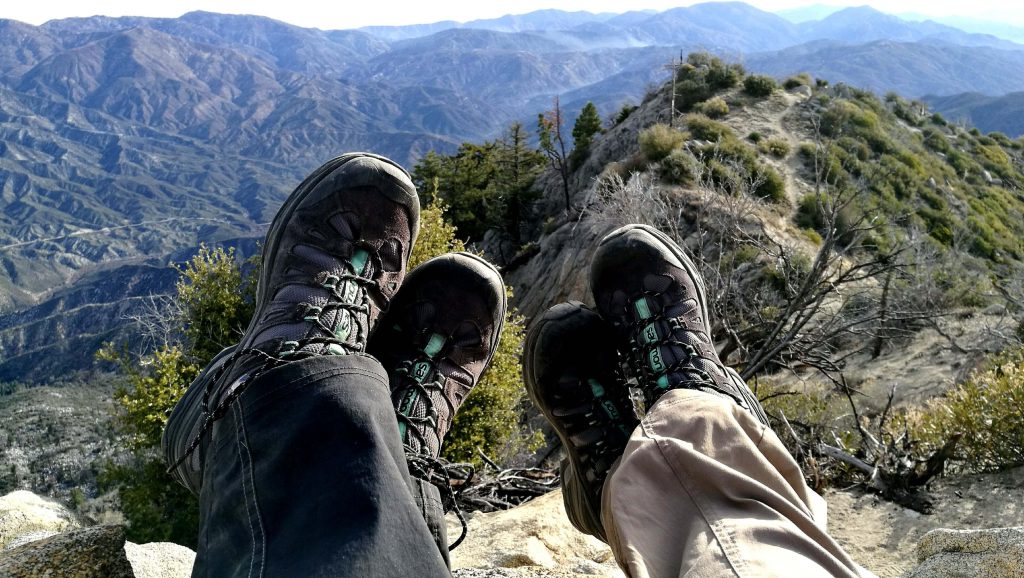
- Buy Shoes Half a Size Larger: Your feet will swell significantly during 4 days of hiking at altitude. Ensure you have a thumb’s width of space in front of your toes so they do not jam against the front of your boots on steep descents.
- Indoor Break-In (10 to 15 Hours): Wear new boots around your house and while doing chores for the first week to soften the upper materials.
- The Two-Sock System: Wear a thin synthetic liner sock underneath a medium-weight Merino wool hiking sock. Friction occurs between the two socks rather than directly against your skin.
- Pre-Tape Hot Spots: Apply Leukotape or Moleskin to known friction areas (heels or sides of toes) on clean, dry skin before starting your hike each morning.
Daypack Weight & Porter Breakdown
On the Classic Inca Trail, licensed porters carry the bulk of your gear, but understanding weight limits is crucial:
- Porter Duffel Bag (5 to 7 kg / 11 to 15 lbs limit): Provided by your tour operator. This holds your sleeping bag, extra clothes, camp shoes, and toiletries. You will only have access to this bag at camp each evening.
- Your Personal Daypack (5 to 6 kg / 11 to 13 lbs): You carry this with you all day. It should contain 2 liters of water, rain poncho, warm layers, camera, sunscreen, personal medication, and snacks.
Essential Acclimatization Strategy for Peru
To ensure your physical training pays off on the trail, integrate these medical and travel protocols into your arrival:
- Sacred Valley Drop Strategy: Do not stay in Cusco city (3,400 m) on Night 1. Head straight from Cusco airport down to lower elevations in the Sacred Valley, such as Ollantaytambo (2,850 m) or Urubamba (2,870 m), to sleep comfortably while your body begins producing red blood cells.
- Altitude Medications: Consult your doctor before departure about Diamox (Acetazolamide) as a preventative measure. Once in Peru, over-the-counter Sorojchi Pills are widely available at pharmacies like Inkafarma for on-demand headache relief.
- Workplace Drug Testing Warning: Sip Muña tea (Andean Mint) for altitude nausea instead of Coca tea if you undergo mandatory workplace drug screenings, as Coca tea can trigger a positive drug test result.
Frequently Asked Questions
Can beginners complete the Inca Trail?
Yes. Beginners who are reasonably fit and take time to acclimatize in Cusco or the Sacred Valley for 2 to 3 days before the trek complete the Inca Trail successfully every day. Pace yourself using the “pole pole” (slowly, slowly) rhythm.
Should I use trekking poles on the Inca Trail?
Yes, trekking poles are strongly recommended. They reduce impact force on your knee joints by up to 25% on downhill stone staircases. Note that the Peruvian government requires trekking poles to have rubber tips to protect ancient Incan stone steps.
What if I cannot complete a 12-week training routine?
Focus on breaking in your hiking boots, completing 3 to 4 StairMaster sessions in the final weeks, and securing at least 2 to 3 full acclimatization days in Peru before your trek departure date.
Can I train on a treadmill if I don’t have access to stairs or outdoor trails?
Yes. Set the treadmill to a 10%–15% incline and walk at a steady 2.0 to 2.5 mph (3 to 4 km/h) while wearing your weighted daypack. To compensate for the lack of downhill training on a treadmill, incorporate slow eccentric step-downs off a bench or box into your leg routine.
How do I prevent knee pain on the thousands of downhill stone steps?
To protect your knees on Day 3’s steep descents, train your quads with eccentric step-downs and reverse lunges, use two trekking poles with rubber tips to absorb impact, and wear supportive knee sleeves if you have a history of joint strain.
What happens if I get altitude sickness on the Inca Trail?
Licensed guides carry emergency medical oxygen, first-aid equipment, and satellite communications on every trek. If severe symptoms occur, your guide will manage your safety and assist you in descending to a lower elevation, which is the fastest and most effective treatment.
Plan Your High-Altitude Expedition with Apple Travel Peru
Navigating the Inca Trail safely requires the right itinerary design, professional guidance, and emergency safety backup:
- Classic 4-Day Expedition: [Book the Official Classic 4-Day Inca Trail Package] – Includes guaranteed government permits, professional bilingual guides, gourmet campsite meals, and full oxygen safety protocols.
- Acclimatization Warmup: [Explore Sacred Valley Day Tours] – Sleep lower and acclimate comfortably before heading onto the trail.
- Custom Treks & Permits: [Browse All Guided Machu Picchu Packages] – Secure your preferred dates with local Cusqueñian experts.